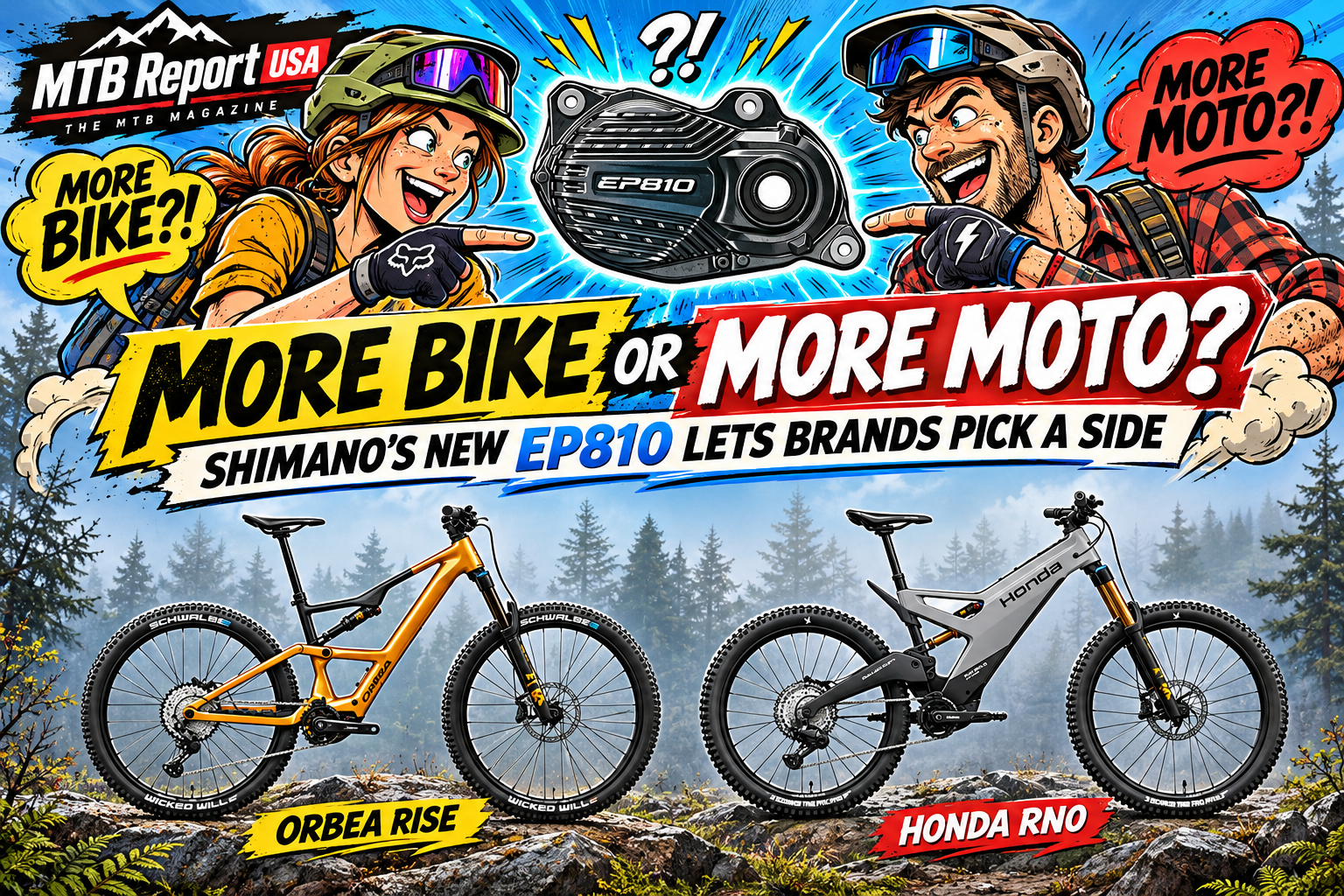
Shimano’s long-awaited eMTB motor is finally official. The first two bikes built around it couldn’t be more different: Orbea made a 37-pound trail bike, Honda a 52-pound machine styled like a dirt bike. Which way the sport goes is up to riders, and in the US, up to the folks who decide where eMTBs can ride.
What Shimano Launched
Shimano officially unveiled the EP810 on November 6, 2026, after photos and specs had already been all over the internet since the start of the week. According to Shimano, the motor weighs 2.3 kg (about 5.1 lb) and puts out up to 100 Nm of torque and 750 W of peak power. Its predecessor, the EP801, was rated at 85 Nm and 600 W and weighed roughly 400 grams (almost a pound) more.
The bigger story is the electronics. Shimano calls it „True Auto“: automatic shifting (Auto Shift, Di2 drivetrains only) teamed up with „Auto Assist,“ which lets the motor adjust its support to the terrain and how you ride in the new Trail+ mode. It backs off on descents and saves battery on flat sections. There’s also a new app, a new 720 Wh battery and a new wireless protocol called D-FLY+. Heads-up if you own an older Shimano e-bike: D-FLY+ doesn’t talk to older Shimano wireless components.
One Motor, Two Directions
The motor only gets interesting once you see what brands do with it. At launch there are exactly two bikes, and they’re about as far apart as two eMTBs can get.
Orbea Rise (2027): Orbea deliberately leaves power on the table. With its own firmware (Orbea calls it „RS“), the motor delivers 100 Nm but tops out at 600 W instead of 750. And instead of Shimano’s 720 Wh battery, Orbea uses its own 420 or 630 Wh packs. The result: from 37.5 lb (17 kg) for the Rise SL with 140mm of travel, and from 39.7 lb (18 kg) for the Rise LT with 160mm up front and 150mm out back. US pricing starts at $6,284 for the SL and $6,614 for the LT, with top builds above $12,000.
Honda RN0: Honda’s first production mountain bike, unveiled at the EICMA motorcycle show in Milan and developed with German brand Rotwild. One-piece carbon frame, a motorcycle-style swingarm, a mullet setup (29″ front, 27.5″ rear), Shimano’s big 720 Wh battery and the full 750 W. Claimed weight: around 52 lb (roughly 24 kg). Don’t go looking for one at your local shop, though: Honda is initially selling the RN0 through select Honda motorcycle dealers in Europe and hasn’t announced any plans for the US.
| Same motor, about 15 pounds apart. The motor doesn’t pick the direction. The brand does. |
Most of that weight comes down to the battery. Motor plus Shimano battery add up to about 14 lb (6.4 kg) before cables, display and mounts, and the 720 Wh battery alone weighs 9 lb (4.1 kg). Shimano doesn’t force brands to use its own battery, though, and that’s exactly the opening Orbea took.
Shimano Sits Out the Power Race
Other brands keep chasing bigger numbers. DJI’s Avinox M2S claims up to 1,500 W and 150 Nm. Shimano isn’t playing that game. The EP810 is an evolution of a proven formula: lighter, a little stronger and a lot smarter.
Before launch, the mood among riders online was mostly impatience. Plenty of people had been waiting on this motor for months while release dates kept slipping. Others shrugged it off, saying their older Shimano motor gets them up every climb just fine and they don’t need more watts.
Early test rides happened on bikes whose hardware and software were still in development. Testers mentioned some rattling from the motor on descents and a noticeable surge when assist cuts out and kicks back in at the speed limit. Whether that carries over to production bikes remains to be seen.
Why „Bike or Moto“ Matters More in the US
In Europe, „more bike or more moto“ is mostly a question of taste. In the US, it’s also a question of where you’re allowed to ride. The Forest Service classifies e-bikes as motor vehicles, so they’re not permitted on non-motorized trails unless those trails are specifically designated for them, and that happens trail by trail. Progress is happening: the Deschutes National Forest near Bend opened about 161 miles of bike trails to Class 1 e-bikes as of April 2026, and the BLM opened roughly 200 miles of Moab trails to Class 1 in March. But it’s slow, and every one of those decisions comes down to whether land managers and other trail users see eMTBs as bikes or as something closer to motorcycles.
Quick refresher: Class 1 means the motor only helps while you pedal and stops assisting at 20 mph. That’s the class most trail openings are limited to, and it’s how bikes like the Rise are sold in the US.
Who Picks the Direction?
Shimano has built a platform that can go either way. Orbea turns it into a light bike that’s meant to feel as close to a regular mountain bike as possible. Honda comes from the moto world and builds a heavy, full-power bike that looks the part. Both are legit and both will find buyers. So the real decision isn’t made in Osaka, it’s made at checkout. What riders buy tells brands which way to build next. More EP810 bikes are expected next year.
Whether these bikes are worth the money is something we’ll only know once production versions have real trail miles on them. What’s already clear: if you’re shopping for a lighter eMTB, the EP810 adds a new option that isn’t built around spec-sheet records.
Bottom line: Open question: Will Orbea’s lightweight approach stay the exception, or will more brands follow?
Your call: more bike or more moto? Which way would you buy? Let us know in the comments below.
Published by Radical Life Studios / MTB Report | USA
- Shimano’s EP810 Is Here, and It’s Smarter, Not Wilder

- Free, Purpose-Built and Adaptive-Friendly: Shaker Ridge Is Open
- Fruita’s 18 Road Gets Its Final Trail, and It’s a Rough One
- Roadless Rule Repeal: What Mountain Bikers Need to Know
- 161 Miles, One Season: How Class 1 E-Bikes Did on Bend’s Trails
- Wie viele Bikes passen wirklich rein? Sunlight UNLTD im Zuladungs-Check
- Canyon’s Avinox-Powered Spectral:ON CF 9 Is a Value Bomb. Here’s the Fine Print.
- Das Bike, das du kaufst, ist nicht das Bike, das du fährst
- Gewinnspiele bei den Radical Life Studios: So bist du dabei
- Nicht China hat den Markt erobert. Wir haben ihn abgegeben.
- Specialized Invented the Light Enduro eMTB — Then Walked Away. Orbea’s Picking It Up.
- Paganella Part 1: The New TOP GUN Trail & Why I Skipped Lake Garda | #MTBlife S04E13


No responses yet