by Robert Langer
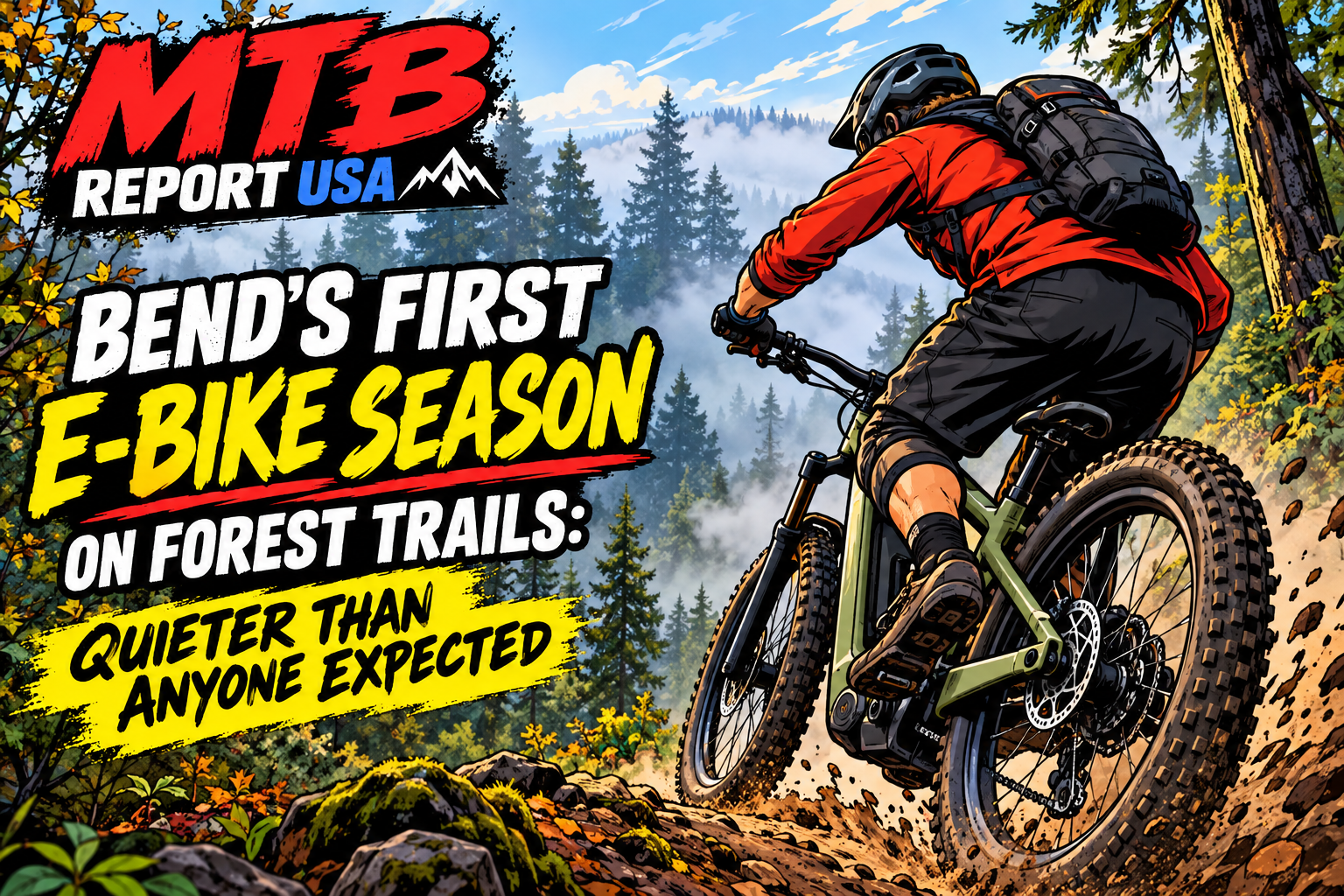
Since April 1, Class 1 e-bikes have been legal on 161 miles of singletrack in the Deschutes National Forest. Eight months in, the Forest Service and the local trail alliance say it went smoothly. The interesting part is what that “smoothly” actually rests on, and what changes on December 1.
What changed in Bend
For years, Bend was one of the strictest e-bike towns in the West. Almost all of its famous singletrack sits on Forest Service land, and the Forest Service treats every e-bike as a motor vehicle. That meant no e-bikes on non-motorized trails, full stop.
That changed with a decision signed by Deschutes National Forest Supervisor Holly Jewkes in December 2025. It opened about 161.4 miles of 67 existing trails to Class 1 e-bikes, starting April 1, 2026. The list covers the Phil’s Trail network, the Wanoga complex, Peterson Ridge near Sisters and the Sunriver area.
A quick explainer for anyone new to the classes: a Class 1 e-bike only helps while you pedal, has no throttle, and stops assisting at 20 mph. Class 2 bikes have a throttle, Class 3 bikes assist up to 28 mph. Only Class 1 is allowed, and bikes that have been modified to go faster are explicitly excluded.
There is a bureaucratic twist behind it. To make this legal, the Forest Service had to mark these trails on its Motor Vehicle Use Map as open to a motorized class. On paper, 161 miles of singletrack became “motorized,” even though dirt bikes and ATVs stay banned.
Where you still can’t ride an e-bike
The rules are a patchwork, so here is the short version for visitors:
- Still closed: trails out of the Skyliners trailhead, Swampy Lakes Sno-park and Dutchman Sno-park, plus the Deschutes River Trail and Mrazek.
- BLM land: Horse Ridge, Cline Buttes and Maston stay closed to e-bikes year-round, even though they are popular winter riding areas.
- From December 1: all Deschutes National Forest trails close to e-bikes until March 31 (details below).
How the first season went
According to the Deschutes National Forest, the first season has generally gone well, with strong partner support for signs and education and no significant ongoing conflicts the agency is aware of.
The Central Oregon Trail Alliance (COTA), the volunteer group that maintains around 600 miles of singletrack in the region and supported the decision, sees it the same way. Board president Bill Lynch told local media the season was “fine,” which is what the club had expected. His view: once riders actually see Class 1 bikes on the trail, most realize it isn’t a big deal.
| The biggest worry was never the Class 1 rider. It was the wrong kind of machine showing up on the same trail. |
That is the open issue. Telling a regular mountain bike from a Class 1 e-bike is hard on the trail. Telling a Class 1 from a Class 2 or 3 is even harder. COTA says it isn’t collecting data on this, so the picture is anecdotal. Lynch has floated an idea that has been circulating among riders: drop the confusing class numbers and call things what they are, something like e-bike, e-moped and e-motorcycle.
Nobody is enforcing it
Here is the part that matters for everyday riders. The Forest Service is not actively enforcing the e-bike rules. In practice that leaves it to mountain bikers to point out when someone is on a closed trail or riding a throttle bike on singletrack.
COTA’s advice is notably relaxed: it isn’t your job to police the trails. If you say something, keep it friendly, more of a heads-up than a confrontation. Whether that holds up as e-bike numbers grow is one of the questions the next seasons will answer.
Why it was approved in the first place
The decision wasn’t popular with everyone. The Oregon chapter of Backcountry Hunters & Anglers collected signatures against it, pointing to illegal e-bike use that was already happening on non-motorized trails. Plenty of local riders were skeptical too. In rider forums, people described Bend as a town full of endurance athletes and XC purists who take a dim view of motors on singletrack.
COTA held meetings and listening sessions in 2022 and 2023. What came out of them was a group that rarely shows up in the debate: riders of all ages for whom a Class 1 e-bike is the difference between riding and not riding, often because of physical limitations. Lynch calls that the most inspiring part, and says he regularly sees regular riders and e-riders out together, keeping the same pace.
For data, COTA points to an earlier Tahoe National Forest study. It found Class 1 e-bikes climb at about 8 to 13 mph versus 5 to 8 mph for regular bikes, without a measurable difference in trail impact.
December 1: the winter closure
Every year from December 1 to March 31, motorized use is banned on Central Oregon forest trails to protect wintering mule deer and elk. Because Class 1 e-bikes are legally motorized on these trails, the closure applies to them too. The Forest Service says it will add e-bikes to its usual winter range messaging.
For visitors this is easy to miss: the trail that was legal for your e-bike in October is not legal in December.
Why this is happening
Bend is not an outlier. In January 2026, the Lake Tahoe Basin opened 112 miles of trail to Class 1 e-bikes, and Moab’s BLM office opened some trails in March. Federal land managers are deciding trail by trail, and Bend’s first season is a data point they will look at.
What the season shows so far: the feared conflicts between pedal riders and Class 1 riders largely didn’t materialize. The real friction sits elsewhere, in classes that are hard to tell apart, in rules nobody enforces, and in a seasonal closure that many visitors won’t know about.
| Adds up for Class 1 on these 161 miles. Open question: how do you keep Class 2 and 3 off singletrack when nobody checks? |
Do you ride in Bend, or somewhere that opened trails to Class 1 recently? Tell us in the comments below how it’s going on your local trails.
Published by Radical Life Studios / MTB Report
FAQ
Can I ride an e-bike on Bend’s mountain bike trails? Class 1 e-bikes are allowed on about 161 miles of Deschutes National Forest trails, including Phil’s, Wanoga, Peterson Ridge and Sunriver, from April 1 through November 30. Class 2 and 3 are not allowed.
Where are e-bikes still banned around Bend? Trails out of Skyliners, Swampy Lakes and Dutchman, the Deschutes River Trail, Mrazek, and BLM areas like Horse Ridge, Cline Buttes and Maston.
Can I ride my e-bike in Bend in winter? Not on Deschutes National Forest trails. The winter wildlife closure from December 1 to March 31 applies to e-bikes as motorized vehicles.
- Free, Purpose-Built and Adaptive-Friendly: Shaker Ridge Is Open

- Fruita’s 18 Road Gets Its Final Trail, and It’s a Rough One
- Roadless Rule Repeal: What Mountain Bikers Need to Know
- 161 Miles, One Season: How Class 1 E-Bikes Did on Bend’s Trails
- Cannondale Is Leaving Connecticut: Global HQ Moves to the Netherlands, Engineering Stays in Germany
- Wie viele Bikes passen wirklich rein? Sunlight UNLTD im Zuladungs-Check
- Canyon’s Avinox-Powered Spectral:ON CF 9 Is a Value Bomb. Here’s the Fine Print.
- Das Bike, das du kaufst, ist nicht das Bike, das du fährst
- Gewinnspiele bei den Radical Life Studios: So bist du dabei
- Lac Blanc ist nicht gerettet. Er wird weiterbetrieben.
- 28 Millionen für Biker? Die neue Loischkopfbahn im Brandnertal | #MTBlife S04E21
- (kein Titel)
- Zwei Meter Sturheit: Baden-Württemberg hält an der 2-Meter-Regel fest
- Nicht China hat den Markt erobert. Wir haben ihn abgegeben.
- #MTBlife S04E20 GEWINNSPIEL So gewinnst du SQlab Handschuhe & ION Knieschoner
- (kein Titel)
- Reparaturpflicht fürs E-MTB: Was am 18. Februar 2027 wirklich passiert
- Nicht China hat den Markt erobert. Wir haben ihn abgegeben.
- NRW-Waldgesetz: Die Trails bleiben. Vorerst.
- Saalbach Hinterglemm | Vom ärmsten Tal zum Home of Lässig · #MTBlife S04E19
- (kein Titel)
- Puricelli Trail, one Take. So sieht der neue Trail im Hunsrück aus
- (kein Titel)
- Mehr Bike, weniger Moped






No responses yet