PUBLISHED BY RADICAL LIFE STUDIOS / MTB REPORT
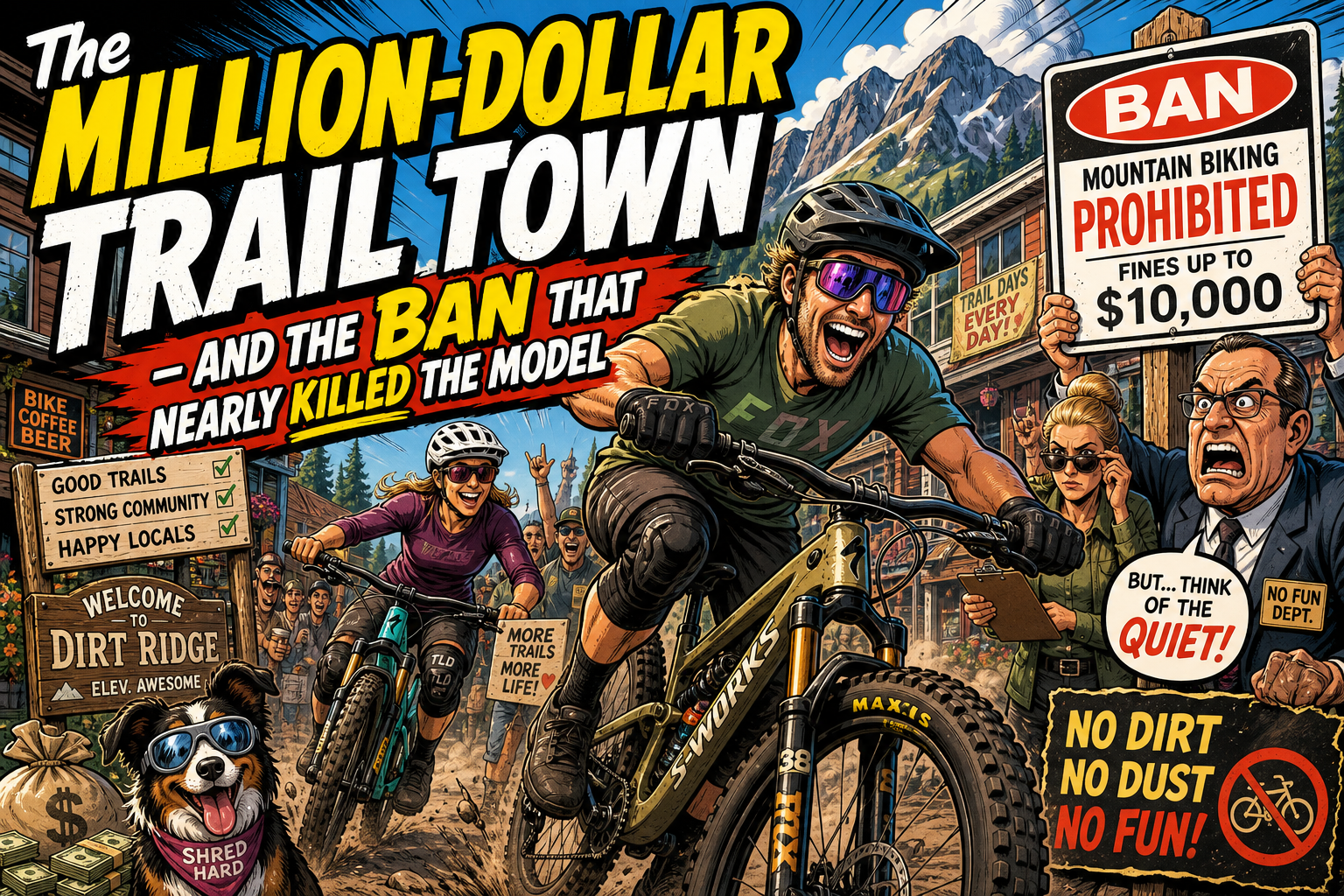
A 5,000-person town in Vermont pulls in around a million dollars a year from mountain bike tourism. A fluke? Hardly. From Arkansas to the Alps, small towns are turning a few miles of singletrack into serious economic engines – and the e-bike has grown the pie faster than anyone expected. Then Germany’s most populous state tried to legislate those trails out of existence – and, after a national backlash, backed down. A lesson in why building beats banning.
By Robert Langer
The Backwater That Banks a Million
Waterbury, Vermont, has barely 5,000 residents – and a big reputation among riders, thanks to the Perry Hill trail network. What began as a local volunteer project is now a hard economic asset. The town logs roughly 15,000 trail visits a year, and according to an economic study by Revitalizing Waterbury and the University of Vermont, those visitors pump about a million dollars annually into the local economy. A day-tripper drops around $45; someone who stays the night, closer to $250. That money lands where it counts: in cafés, bike shops, inns and Main Street retail.
And it isn’t only about the cash. The trails have become a location asset in their own right. In an era when skilled workers and remote employees can pick where they live, a town like this competes on quality of life: world-class riding minutes from the back door. Young families are moving there on purpose.
Not a One-Off – From Pattern to Playbook
Waterbury isn’t an outlier; it’s part of a pattern. Zoom out and the scale becomes clear: mountain bike tourism in Vermont alone recently generated about $27.9 million in direct visitor spending, according to the Vermont Mountain Bike Association, across roughly half a million trail visits a year. An analysis by the Trust for Public Land and IMBA – the International Mountain Bicycling Association – pegs average spending per bike visit at around $416, with plenty of destinations running well above that.
The headline example is Bentonville, Arkansas: an unremarkable region that built hundreds of miles of singletrack and crowned itself the mountain bike capital of the world, with a bike economy well past the $100-million mark. And in rural Vermont, the Kingdom Trails network draws about 94,000 visitors a year – good for more than $10 million in economic value. Same recipe every time: build the trails, the guests come, the town comes back to life.
The E-Bike Factor – Who Actually Grew the Pie
So far, so familiar. What these success stories tend to leave out is the e-bike – which is odd, because it’s a big reason the pie has grown so fast.
E-MTBs now make up nearly 40% of the entire e-bike market. And they put exactly the people on the trail who used to stay home: older riders, the less fit, comeback riders, families, people with physical limits. In other words, the broad middle of everyday riders – not the racing crowd.
In tourism, that lands hard. E-MTB rentals are growing double digits, and bike regions report that an e-bike fleet earns roughly 40% more per day than a fleet of analog (“acoustic”) bikes. The logic is simple: riders who don’t have to grind up every climb stay longer, ride more and come back – and book the guided tour they’d never have signed up for under their own steam. As a bonus, the e-bike stretches the season into the shoulder months that used to sit dead.
Worth flagging for the US reader: the category doing the heavy lifting is the Class 1 pedal-assist e-bike – pedal-only, no throttle, capped at 20 mph – which is also the version most land managers and IMBA are comfortable allowing on non-motorized trails. That overlap between what grows the economy and what keeps trail access intact is the whole ballgame.
| The e-bike grew the pie – it didn’t shrink it. |
It Works in Europe, Too
You don’t have to cross the Atlantic for this. It’s been working in Europe for years.
Take Winterberg, in Germany’s Sauerland region. The town now clocks around 1.3 million overnight stays a year and has pulled off the leap from pure winter-sports resort to year-round destination – there are summers where August books more nights than January, driven partly by the bike park and its trails. The surrounding “Bike Arena Sauerland” signs some 700 kilometres (over 430 miles) of routes, plus a family-friendly trail park built for exactly the beginners and cruisers we’re talking about. Local tourism figures attribute roughly 60% of the region’s economic output to tourism; the town itself calls the value created by the bike scene an “indispensable” part of its economy.
Closer still to the Vermont script is Germany’s Erzgebirge, the Ore Mountains. Where mining once carried the region and its decline hollowed out the prospects, trails now bring fresh revenue: the Stoneman Miriquidi route and the Rabenberg trail centre alone generate around €1.73 million a year (roughly $1.9 million), according to Germany’s Mountain Bike Tourism Forum. A former mining district, reborn on two wheels – the very same story that made the old tin-mining town of Derby, in Tasmania, world-famous.
The Ban That Nearly Killed the Model
Which makes what happened next so instructive. North Rhine-Westphalia – Germany’s most populous state, and home to Winterberg, one of the country’s biggest bike destinations – very nearly legislated its own trails out from under itself. This spring, a draft forestry law would have restricted forest riding to tracks at least 3.5 metres (about 11 feet) wide. Translation: almost every singletrail – every narrow path – would have become illegal overnight.
What happened next is the good news. The backlash was national and broad: from the mountain bike association DIMB to the state’s MTB coordination group to the local bike industry. And, notably, from the foresters themselves – North Rhine-Westphalia’s professional forestry union came out under the banner “dialogue, not criminalization,” pointing to the Sauerland’s long-running round tables between landowners, conservation bodies, towns, tourism and rider groups as the model to follow.
| Build beats ban – a German state just proved it. |
The ministry backed down. After the hearings, the assurance is that riding on the existing network stays as it was – no downgrade. The ban is shelved, for now. Put another way: the state swerved just in time, before scoring an economic own goal. You can’t easily outlaw the value your own Sauerland is busy calling “indispensable.”
Don’t uncork the champagne yet, though. The banning reflex hasn’t vanished; it has merely changed venues. Neighbouring Baden-Württemberg still enforces its notorious “two-metre rule” – singletrack narrower than two metres is off-limits – and a national forest-law debate keeps simmering. For riders in the UK it should ring a bell: access is never a given. Scotland’s Outdoor Access Code, the liberal right to roam that welcomes bikes across most terrain, is the gold standard precisely because it’s the exception, not the rule. South of the border, and across much of the Continent, access is patchier – and always one bad law away from shrinking.
And here’s the through-line the German near-miss makes obvious: access isn’t a lifestyle footnote, it’s economic policy. Conflict on the trail is real – more traffic means more responsibility, for the trails and for one another – but the answer is to build, manage and maintain, not to lock people out. And it’s the right e-bike. Access rows rarely flare up over the light, sensible pedal-assist the family down the road rides; they flare up over the chipped 1,000-watt mopeds that share nothing with a mountain bike but the tyre width. More bike, less moped – that isn’t an aesthetic preference. It’s the precondition for keeping trails open and the tills ringing.
Waterbury worked out long ago that a few miles of dirt can be worth more than another business park. North Rhine-Westphalia figured it out just in time. You don’t need a crystal ball to guess which regions will be better off in ten years: the ones that built – not the ones that banned.
MTB Report · mtb-report.com · Published 26 July 2026
- Specialized Invented the Light Enduro eMTB — Then Walked Away. Orbea’s Picking It Up.

- Paganella Part 1: The New TOP GUN Trail & Why I Skipped Lake Garda | #MTBlife S04E13
- Plötzlich Vollgas: Warum die Bike-Industrie wieder erfindet und wer die Richtung bestimmt
- MTBlife S04E09 | 3-Länder Enduro Trails Nauders – Ein Tag, drei Länder, ehrliche Trails
- The Derailleur Is Dying. The Wattage War Isn’t. Avinox MG vs. Gobao – Inside the Gearbox Fight
- Schaltwerk ade? Avinox MG und Gobao X1P – die Getriebe-Revolution hat einen Haken
- Zugspitzpark Ehrwald – The Complete Guide for Your Visit
- Tiroler Zugspitz Arena MTB Geheimtipp am Fuß der Zugspitze – Biberwier & Lermoos #MTBlife
- Warum Deutschland endlich aufhören sollte, sich für seine Flagge zu entschuldigen
- Größter Indoor-Bikepark der Welt – die unglaubliche Geschichte von Ray Petro
- Atemberaubende FPV-Drohnenaufnahme zeigt Red Bull Hardline aus völlig neuer Perspektive
- Blindsee Trail: Warum die „Sperrung“ keine ist – und wo die Lösung schon wartet

No responses yet